Back to Nova Southeastern University


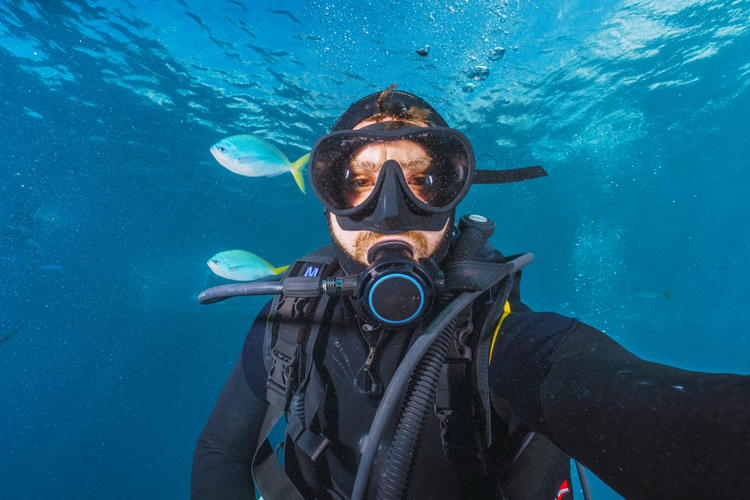
Everything that humans do impacts marine ecosystems and in turn, marine ecosystems impact the lives of humans. Nova Southeastern University’s M.S. in Marine Sciences program gives you the opportunity to dive deep into the study of marine systems, learning about a variety of special topics, including everything from shark research to coral reef reservation.
What better place to advance your education in marine science than at a university with an entire campus and marina devoted to the field? NSU is uniquely located at the edge of diverse marine, freshwater and terrestrial ecosystems allowing students, faculty, and researchers to engage in multidisciplinary studies.
At NSU, you’ll have immersive learning experiences laboratory and classroom settings as well as on the field. Mangroves, coral reefs, tropical freshwater, beaches, and deep-water habitats are just a few miles away from campus, which means you’ll have plenty of opportunities to work hands-on in the environments that match your interests.
Choose From Three Marine Science Concentrations
Quick Facts





Winter 2026: Friday, November 14, 2025
Summer 2026: Friday, April 17, 2026
What Beats a School by the Ocean? A School in the Ocean
The Oceanographic Campus is a dedicated 10-acre research hub for the Department of Marine and Environmental Sciences. Its state-of-the-art NSU Guy Harvey Oceanographic Research Center provides environmentally friendly, LEED-certified facilities for multidisciplinary coral reef research across five key thematic areas. Equipped with advanced laboratories and resources, the campus offers students and faculty opportunities for cutting-edge research in marine science.
Launch the Full Tour Schedule Your Visit
Marine Science Curriculum
Core Courses (9 credits)
Credits
Marine Biology Concentration (choose a minimum of 18 credits**)
Credits
Coastal Zone Management Concentration**
Credits
Marine Environmental Science Concentration (choose a minimum of 18 credits**)
Credits
Capstone or Thesis Path+
Credits
** Choose an additional (3) credit hours from courses in any of the three concentrations
+ Students are allowed to take one elective outside their concentration and have it count toward their final credit total. After completing the required core and concentration coursework, students must take two required capstone courses, totaling 6 credits.
For specific course requirements, refer to the “Master of Science in Marine Science Program (M.S.)" in NSU's Halmos College of Arts and Sciences Graduate Program Catalog.
The academic program and curriculum requirements listed on this page are from the NSU Halmos College of Arts and Sciences Graduate Student Catalog. Students are bound by policies and curricula published in the catalog in effect the semester they enter the university unless an agreement is made with appropriate NSU administration officials allowing them to abide by policies published in a later catalog.
Join us on Thursday, October 15, 2026 at 12:30 P.M. EST to learn more about our marine/environmental sciences, including careers within the field, NSU graduate degree offerings, and the application process.
This event is free and open for all to attend.
Program directors and department faculty from the Department of Marine and Environmental Sciences and will be in attendance to answer your questions about your program(s) of interest.
- Completed NSU Graduate Application and $50 Application Fee
- Transcripts from all previously attended higher education institutions including degree
conferral.
- (Applicants who have not yet completed their undergraduate degree programs may submit official transcripts prior to degree conferral to be considered for provisional admission. Final official transcripts must be submitted to receive full admission into the program.)
- Undergraduate GPA of +2.85 or higher to apply
- For non-native English speakers and graduates of foreign institutions (where English
is not the primary language instruction). Demonstrate English-language proficiency
is required through one of the following options:
- Successful completion of a degree at an approved U.S. institution of higher education where English is the primary language of instruction.
- Test of English as a Foreign Language (TOEFL) official score of 213 on the computerized test, 550 on the paper test format, or 79 on the Internet format.
- Submit a 'Resume' OR 'Curriculum Vitae'
- Suggestion: Have a small section discussing your research interests within the marine/environmental sciences; 4-5 sentences max. Additionally, you should have two references – ideally, academic sources, but relevant professional sources are still welcome.
-
Non-native English speakers and graduates of foreign institutions (where English is not the primary language instruction) must demonstrate English-language proficiency through one of the following options:
- Successful completion of a degree at an approved U.S. institution of higher education where English is the primary language of instruction.
- Test of English as a Foreign Language (TOEFL) official iBT score of 80+ (old test scale) or 4+ (new test scale).
- Applied Statistics or Biostatistics
- Biology I with Lab
- Biology II with Lab
- Chemistry I with Lab
- Calculus I or higher
- One or more of the following: Anatomy, Ecology, Geology, Physiology (general or basic level)
Note: The above-listed courses must be completed prior to acceptance to the MS in Marine Science. NSU’s Department of Marine and Environmental Sciences will review similar coursework as possible substitutes upon request.
Join us on Thursday, October 15, 2026 at 12:30 P.M. EST to learn more about our marine/environmental sciences, including careers within the field, NSU graduate degree offerings, and the application process.
This event is free and open for all to attend.
Program directors and department faculty from the Department of Marine and Environmental Sciences and will be in attendance to answer your questions about your program(s) of interest.
- Completed NSU Graduate Application and $50 Application Fee
- Transcripts from all previously attended higher education institutions including degree
conferral.
- (Applicants who have not yet completed their undergraduate degree programs may submit official transcripts prior to degree conferral to be considered for provisional admission. Final official transcripts must be submitted to receive full admission into the program.)
- Undergraduate GPA of +2.85 or higher to apply
- For non-native English speakers and graduates of foreign institutions (where English
is not the primary language instruction). Demonstrate English-language proficiency
is required through one of the following options:
- Successful completion of a degree at an approved U.S. institution of higher education where English is the primary language of instruction.
- Test of English as a Foreign Language (TOEFL) official score of 213 on the computerized test, 550 on the paper test format, or 79 on the Internet format.
- Submit a 'Resume' OR 'Curriculum Vitae'
- Suggestion: Have a small section discussing your research interests within the marine/environmental sciences; 4-5 sentences max. Additionally, you should have two references – ideally, academic sources, but relevant professional sources are still welcome.
-
Non-native English speakers and graduates of foreign institutions (where English is not the primary language instruction) must demonstrate English-language proficiency through one of the following options:
- Successful completion of a degree at an approved U.S. institution of higher education where English is the primary language of instruction.
- Test of English as a Foreign Language (TOEFL) official iBT score of 80+ (old test scale) or 4+ (new test scale).
- Applied Statistics or Biostatistics
- Biology I with Lab
- Biology II with Lab
- Chemistry I with Lab
- Calculus I or higher
- One or more of the following: Anatomy, Ecology, Geology, Physiology (general or basic level)
Note: The above-listed courses must be completed prior to acceptance to the MS in Marine Science. NSU’s Department of Marine and Environmental Sciences will review similar coursework as possible substitutes upon request.
Program Director and Admissions Staff
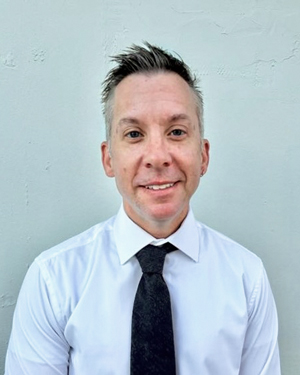
James Kerfoot, Ph.D.
Department Chair and Professor, Department of Marine and Environmental Sciences