Back to Nova Southeastern University


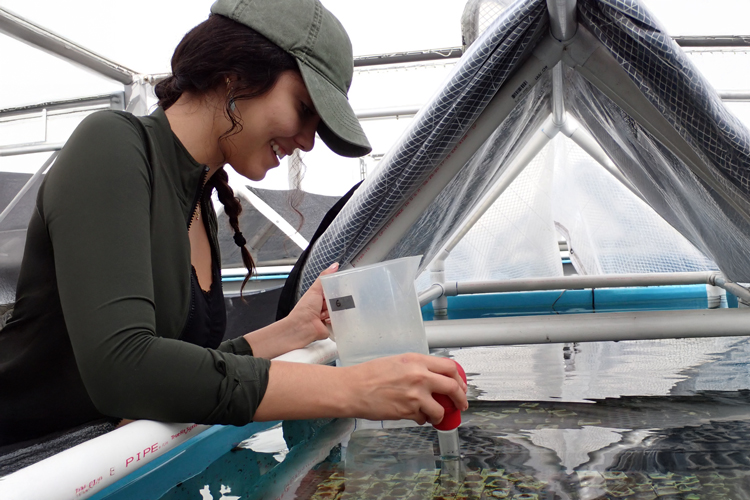
You’re ready to take your interest in marine environments to the next level. Nova Southeastern University’s (NSU's) Doctor of Philosophy (Ph.D.) in Marine Biology/Oceanography prepares you for further research on a selected topic of importance in the ocean sciences. You can focus on marine biology or physical oceanography, aligning your interests to your personal and career goals.
NSU is also home to several institutes including the Broward County Sea Turtle Conservation Program, NSU's Guy Harvey Research Institute, Marine Environmental Education Center, the National Coral Reef Institute, and the Save Our Seas Foundation Shark Research Center. As a graduate student, you’ll have access to expert faculty members and leading researchers studying everything from shark movement patterns to coral reef conservation. Upon completion of this program, you’ll be prepared for careers in academia, industry, and government.
Quick Facts





Winter 2026: Friday, November 14, 2025
Summer 2026: Friday, April 17, 2026
Shark Sightings
Every student has a story. The “Shark Sightings” video series highlights undergraduates, graduate students, and NSU alumni who are diving into their coursework, getting involved in extracurriculars, and using their education to make a difference in their chosen fields.
Learn why each Shark says they chose NSU, and how their degree is preparing them to dominate.
Admissions Requirements



Transcripts

Letter of Endorsement

Minimum GPA

Resume

English Proficiency
- Successful completion of a degree at an approved U.S. institution of higher education where English is the primary language of instruction.
- Test of English as a Foreign Language (TOEFL) official iBT score of 80+ (old test scale) or 4+ (new test scale).
Learning Outcomes
A successful recipient of the Ph.D. in Oceanography/Marine Biology is expected to:
- Understand basic marine biological, chemical, geological, and physical processes to a level sufficient to communicate and collaborate with experts in those sub-disciplines; and to be able to apply this knowledge to issues in research and resource management
- Apply the scientific method to define, investigate, and evaluate hypotheses in at least one of these sub-disciplines
- Conduct (as guided by, and to the satisfaction of, the doctoral committee and NSU's Halmos College faculty) advanced, original, and independent research that adds to the body of oceanographic knowledge in one or more of the sub-discipline areas
- Communicate scientific results and conclusions clearly and logically in a written dissertation and in scientific presentations and publications
Join us on Thursday, October 15, 2026 at 12:30 p.m. to learn more about our marine/environmental sciences, including careers within the field, NSU graduate degree offerings, and the application process.
This event is free and open for all to attend.
Program directors and department faculty from the Department of Marine and Environmental Sciences and NSU Halmos College of Arts and Sciences Graduate Admissions will be in attendance to answer your questions about your program(s) of interest.
The Department of Marine and Environmental Sciences will accept a total of 30 credits from previous graduate coursework. Coursework must replicate NSU offerings in the major field of interest or must be closely related. Transfer credits must be graduate-level from accredited institutions. Students are required to consult with a program coordinator regarding the Transfer of Credit policy.
Students are expected to complete the Ph.D. in Oceanography/Marine Biology within 5 years of full-time study, and within 9 years in the case of part-time students. A minimum of 3 years enrollment in the Ph.D. program is required.
Join us on Thursday, October 15, 2026 at 12:30 p.m. to learn more about our marine/environmental sciences, including careers within the field, NSU graduate degree offerings, and the application process.
This event is free and open for all to attend.
Program directors and department faculty from the Department of Marine and Environmental Sciences and NSU Halmos College of Arts and Sciences Graduate Admissions will be in attendance to answer your questions about your program(s) of interest.
The Department of Marine and Environmental Sciences will accept a total of 30 credits from previous graduate coursework. Coursework must replicate NSU offerings in the major field of interest or must be closely related. Transfer credits must be graduate-level from accredited institutions. Students are required to consult with a program coordinator regarding the Transfer of Credit policy.
Students are expected to complete the Ph.D. in Oceanography/Marine Biology within 5 years of full-time study, and within 9 years in the case of part-time students. A minimum of 3 years enrollment in the Ph.D. program is required.
Program Director and Admissions Staff

James Kerfoot, Ph.D.
Department Chair and Professor Department of Marine and Environmental Sciences